
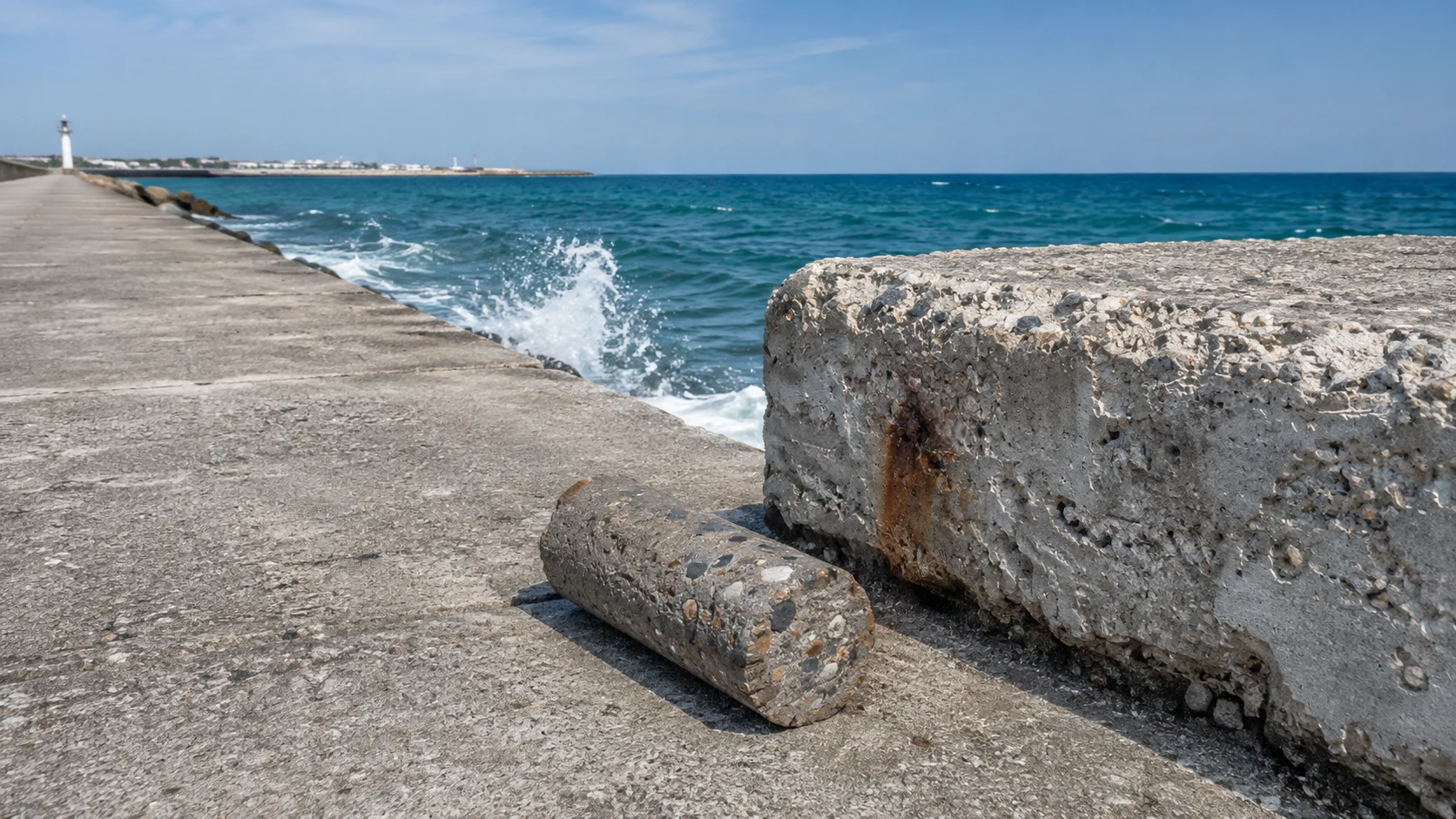
Why this review exists
The brochure life of a coastal material rarely matches its measured life once tidal cycling, ambient temperature, and contractor inconsistency enter the equation. This piece compares seven material systems on quantified durability metrics drawn from peer-reviewed field studies and ACI and fib guidance.
The single most predictive variable for coastal-structure durability is not the headline material choice. It is whether the concrete cover specified in the drawings is actually achieved on site, verified by cover-meter survey at handover. On coastal projects, cover non-conformance accounts for more premature corrosion findings than any single material substitution.
What does "high-salinity coastal" actually mean for design?
In Eurocode 2 terms, high-salinity coastal structures of this kind sit in exposure class XS3, tidal and splash zone, the most aggressive of the chloride-from-seawater categories (Beushausen, Structural Concrete, 2021). SANS 10100-2:2014 mirrors the XS3 definition and ties it to minimum cover and binder requirements for South African marine structures. For the Gulf, Libyan and Turkish coastlines, design teams blend EN 1992-1-1 cover provisions with national annex modifications and, where the client allows, the probabilistic service-life model in fib Model Code 2010.
A working shorthand on procurement calls: XS3 means at least 55 millimetres of cover for a fifty-year design life with a CEM I mix, and a binder system that drops the chloride diffusion coefficient below about 3 × 10⁻¹² m²/s at 28 days. Hit those two numbers reliably and the structure has a fighting chance.
Does high-volume GGBS deliver in real marine service?
Ground granulated blast-furnace slag (GGBS) at high replacement ratios is the workhorse of credible Mediterranean and Gulf marine concrete. The slow secondary hydration refines the pore structure, lowering chloride diffusivity by an order of magnitude against a plain CEM I control once mature (Dang et al., Construction & Building Materials, 2026).
Well-cured high-GGBS mixes at a low water-to-binder ratio hold chloride content at rebar depth below the 0.40 percent by mass of binder threshold that ACI 222R-19 cites as the corrosion-initiation limit, whereas comparable CEM I mixes built in the same era tend to reach or exceed it within the first decade of marine exposure (ACI 222R-19 preview).
The honest caveat: GGBS is slow. Early-age strength gain in winter pours is a real programme risk, and curing extensions a contractor did not initially price can follow. The trade-off is documented in fib Bulletin 76, which benchmarks European, US and Australian standards against probabilistic chloride-ingress models (fib Bulletin 76 summary). For South African coastal projects, high-volume GGBS is the sensible default, and it falls within the civil and structural service line.
Where does silica fume actually earn its premium?
Silica fume at 7 to 10 percent replacement, often blended with GGBS in a ternary system, is specified for highly aggressive splash-zone elements. Long-term field data from harsh marine exposure, including studies on Persian Gulf and Mediterranean piers, shows that silica fume reduces the chloride diffusion coefficient measurably up to about 7.5 percent replacement, with diminishing returns above that (Bouhamou et al., Cement & Concrete Composites, 2015).
Silica-fume ternary mixes are placeable but unforgiving. Curing discipline matters more than the spec sheet implies, and the cost premium over a straight high-GGBS mix is meaningful. The argument for using it on every project does not hold; the argument for using it on the most exposed elements does.
A recent machine-learning sensitivity study on time-dependent chloride diffusion in Mediterranean concrete confirms what site teams already know: water-to-binder ratio, cover depth, and curing temperature account for most of the variance in measured service life (Mahmoodi et al., Construction & Building Materials, 2025).
When is stainless reinforcement the right choice?
Stainless reinforcement is expensive, and on most projects it is the wrong answer. On a small number of projects, it is the only answer that makes lifecycle sense. The reference case the industry still leans on is the Progreso Pier on the Yucatán coast, built in 1941 with austenitic stainless reinforcement and still substantially intact at over eighty years of tropical marine exposure, against the failed carbon-steel pier built next to it and demolished decades ago (60-year stainless pier performance study).
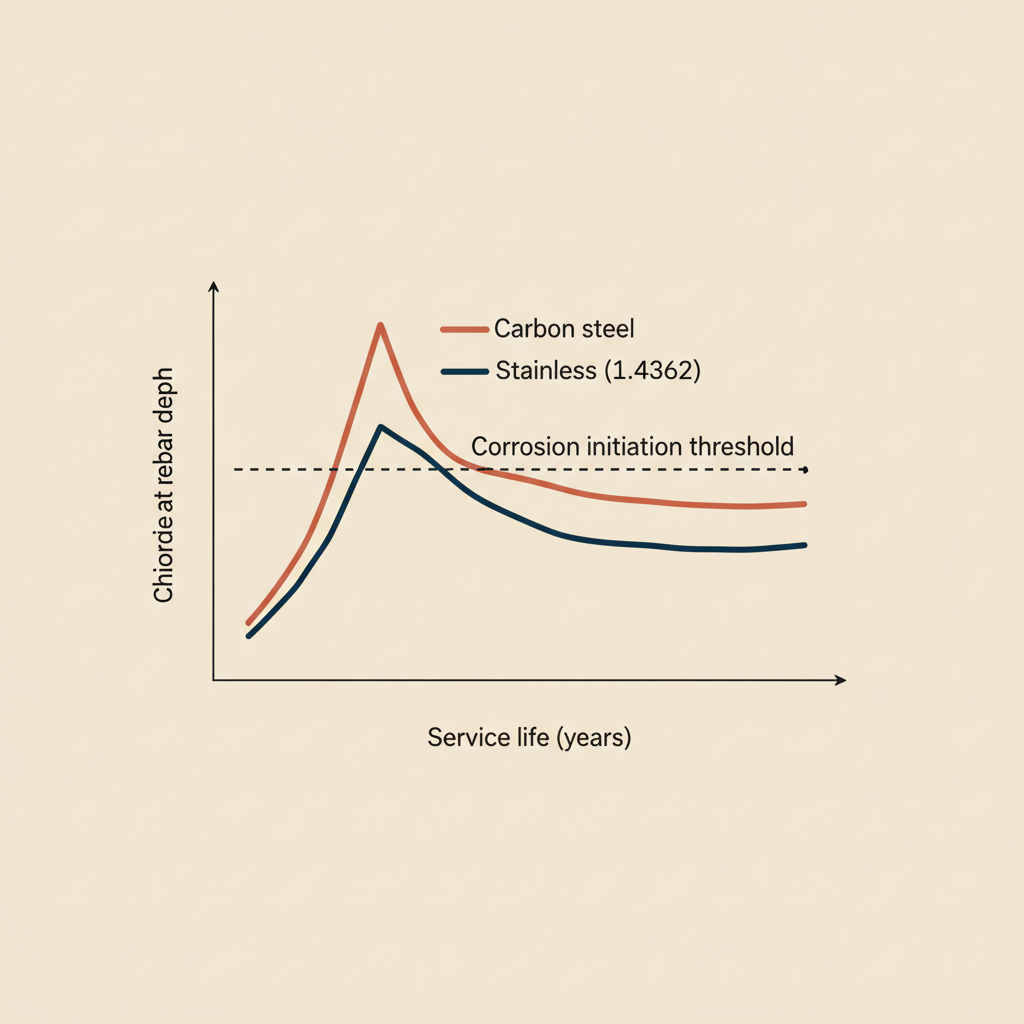
For modern work, the lean duplex grades UNS S32304 and UNS S32205 give corrosion resistance close to 316L at lower nickel cost (CORROSION journal, S32205 and S32304 rebar reproducibility). Life-cycle costing on a major Hong Kong pier project came in favour of stainless when discounted maintenance over a 120-year horizon was included (Hutchinson and Toulouse, International Journal of Life Cycle Assessment, 2016).
The galvanic risk when stainless rebar is mixed with carbon-steel rebar in the same structural element is real but routinely overstated. In separated zones, with appropriate detailing and stainless reserved for the tidal splash zone, mixed use is workable.
Has FRP rebar matured into a credible default for marine work?
Citation CapsuleIn Mediterranean and Gulf coastal service, three material systems consistently hold their published performance: high-volume GGBS-blended concrete, austenitic stainless reinforcement in tidal-splash zones, and properly maintained galvanic cathodic protection on existing structures. Silane impregnation, sacrificial anodes, and first-generation FRP rebar tend to underperform expectation in real service.
Fibre-reinforced polymer rebar (FRP) was promoted hard in the early 2010s as the corrosion-proof future of marine concrete. The reality has been more mixed. GFRP and BFRP bars do not corrode in the electrochemical sense that carbon steel does, but they degrade under sustained alkaline-and-chloride exposure, and the durability conversation has shifted from "if" to "how fast" (USDOT BFRP rebar characterization, 2024).
For most coastal work, FRP is not yet a safe default. The combination of immature local supply chains, conservative national codes, and limited long-term field data means it is better treated as a project-specific option than a category answer. That position is consistent with the cautious tone in the recent peer-reviewed literature on long-term FRP durability under marine exposure (review article on coastal silane and FRP performance, ScienceDirect, 2024).
How long does silane impregnation actually protect a marine structure?
Hydrophobic silane impregnation has a real and measurable effect on chloride ingress when it is applied correctly and reapplied on schedule. The silane lines the capillary pores, water beads off, chloride ingress slows. Published field data shows a useful residual effect at twelve years in aggressive marine exposure, with a hydrophobic signature still detectable on some structures at twenty years (Christodoulou et al., Construction & Building Materials, 2013).
The honest part is what happens between applications. Chloride-ingress rate rebounds measurably as the hydrophobic layer ages, before reapplication. If the operator's maintenance regime does not include a documented reapplication schedule, the published performance is not what a structure will get. Silane is best treated not as a stand-alone durability strategy on new build, but as one layer in a defined retrofit programme.
Is sacrificial-anode cathodic protection a real life-extension tool?
For existing structures with carbon-steel reinforcement and visible chloride contamination, galvanic cathodic protection using sacrificial zinc anodes is one of the most credible life-extension tools available. The mechanism is well documented, and the case-study record on the Arousa Island Bridge in northwest Spain, a Mediterranean-adjacent structure repaired with hybrid galvanic CP in 2011 and re-tested in 2023, shows the system holding up under continued chloride exposure (Sánchez et al., MDPI Infrastructures, 2025; FHWA cathodic-protection case study).
The limits are real. FHWA field data shows many anodes failing between five and fifteen years in service, and replacement is part of the design assumption from day one. A credible twenty-year cost model only works once anode replacement is priced in honestly. Sacrificial CP is a recurring maintenance commitment that buys two to four decades of additional life on a structure that would otherwise need full replacement.
Does ECC justify its premium on repair overlays?
ECC, the strain-hardening fibre-reinforced cementitious composite developed at Michigan and the University of Tokyo, is among the most credible repair-overlay options for chloride-contaminated marine concrete. The crack-width control, with fine self-healing cracks below sixty micrometres under load, materially reduces chloride penetration into the substrate (Wang et al., Cement & Concrete Composites, 2025).
The cost premium against a conventional repair mortar is substantial, often two to three times per cubic metre. The case for it strengthens sharply on assets where access for re-repair is expensive or operationally disruptive. It is best reserved for splash-zone overlays where the cost of a return visit dominates the lifecycle calculation.
What does the comparison table look like in practice?
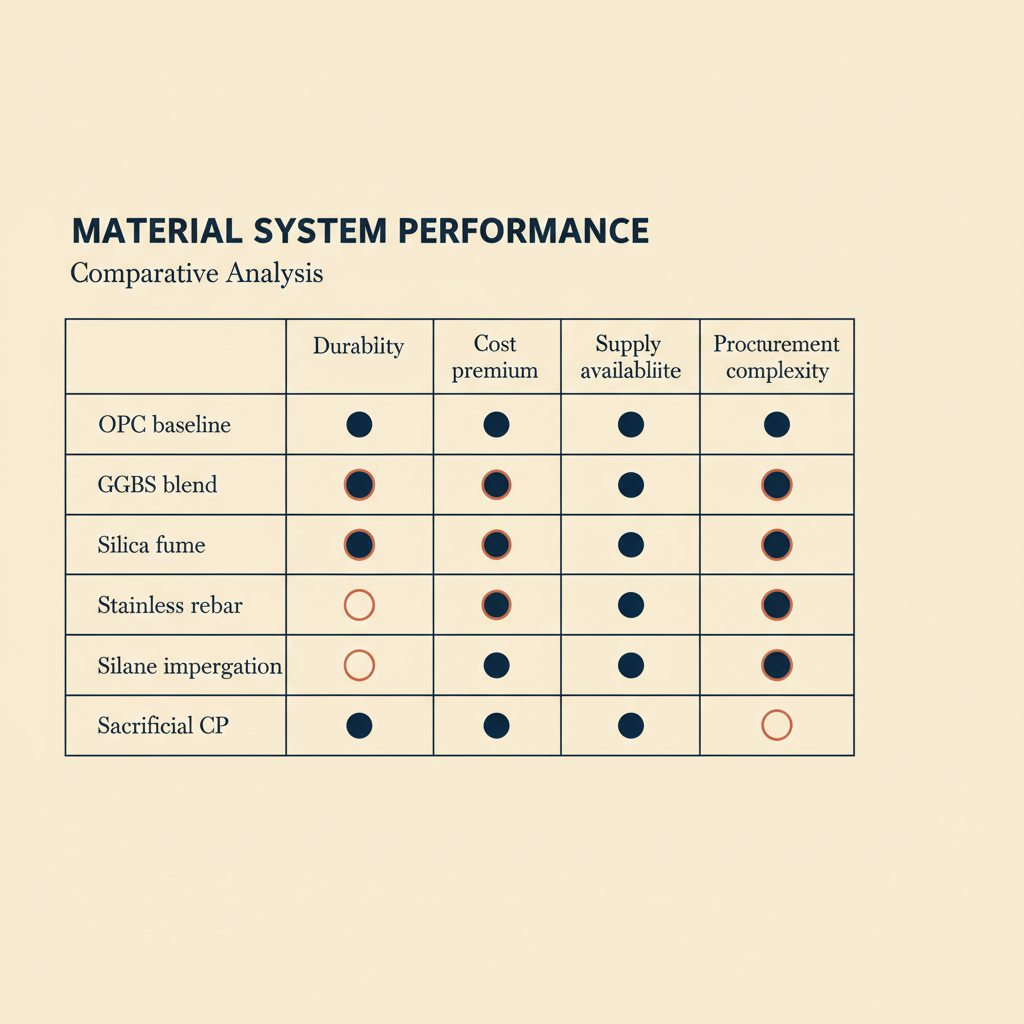
The comparison below summarises typical positioning across the seven systems for high-salinity coastal work. The figures reflect field performance rather than laboratory optima.
| System | Typical uplift vs CEM I baseline | Cost premium (relative) | Honest weakness | Where it fits |
|---|---|---|---|---|
| High-volume GGBS (50 to 70 percent) | +30 to +50 years | 1.05x to 1.15x | Slow strength gain, curing-sensitive | Default for XS3 new build, all four countries |
| Silica-fume ternary (7 to 10 percent) | +40 to +60 years | 1.15x to 1.30x | Placement-sensitive, requires disciplined curing | Highest-exposure splash-zone elements |
| Austenitic / lean duplex stainless rebar | +60 to +100 years | 4x to 8x rebar cost | Capital cost, supply chain | Tidal-splash zones on long-life assets |
| GFRP / BFRP rebar | Comparable on paper, less mature in field | 2x to 4x rebar cost | Bond and anchorage degradation, limited field data | Project-specific only |
| Silane surface impregnation | +5 to +10 years per application | Low capital, high recurring | Requires disciplined reapplication | Retrofit layer, not stand-alone |
| Sacrificial-anode CP | +20 to +40 years on existing structures | Moderate capital, recurring | Anode replacement at 10 to 15 years | Existing chloride-contaminated structures |
| ECC repair overlay | +15 to +30 years on repaired element | 2x to 3x conventional mortar | Cost, specialised placement | Repairs where re-access cost dominates |
How should climate projections change the specification?
The IPCC AR6 sea-level projections for the Mediterranean are not abstract. The northern Mediterranean coastline shows revised 2100 projections up to about 1.1 metres higher than the original AR6 estimates in subsiding zones, with localised values approaching 2.9 metres by 2150 in worst-case scenarios (Antonioli et al., Environmental Research Letters, 2024). For Gulf-coast assets, recent geospatial work shows up to forty percent coastal land loss in vulnerable cities by 2130 under combined sea-level and subsidence scenarios (Springer Natural Hazards, 2025).
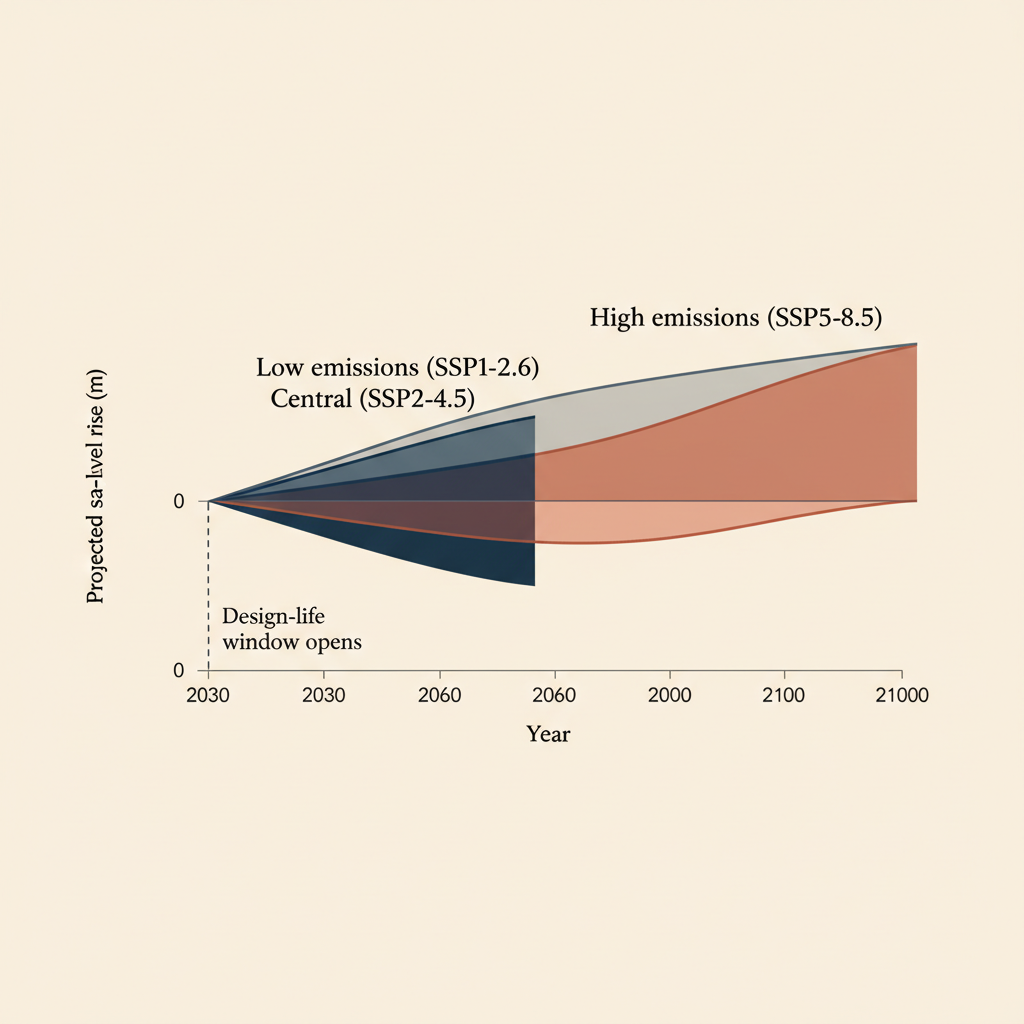
The implication for the specification is straightforward, and it shifts the default in two ways. First, splash-zone elevation on new coastal structures is increasingly raised by 300 to 500 millimetres against the pre-2020 baseline. Second, the durability-design horizon on critical assets is being extended from the standard fifty-year code minimum to a project-specific seventy-five-to-one-hundred-year horizon, which materially shifts the cost-benefit case toward stainless reinforcement and high-replacement-ratio binder systems.
What does the procurement officer actually need to ask?
Three questions, on every coastal project, before specification is locked.
First: what is the cover-meter survey protocol at handover, and what is the rejection criterion for non-conformance? Without that, the specified material system is academic.
Second: what is the reapplication, anode-replacement or repair-access budget over the design life, priced honestly into the operator's twenty-year cost model? The answer separates a real life-extension strategy from a brochure-life claim.
Third: which national code governs, and which clauses in the national annex modify the European or American base standard? In practice, the national annex modifications in the Gulf and the Mediterranean materially change the cover and binder requirements for XS3 elements, and a generic Eurocode 2 specification will not satisfy the local authority sign-off.
On coastal projects, the civil and structural and architectural design teams address these three questions at concept stage, before the durability spec is committed. A recurring pattern in coastal durability engineering is that failures trace back to procurement-stage decisions rather than site-stage decisions. Related pieces in this cluster, on desert thermal management, Libyan reconstruction seismic design, and green concrete in high-heat arid climates, sit in the Insights archive.
Frequently asked questions
What is the most cost-effective material upgrade for a thirty-year coastal asset?
For a new-build asset in XS3, the highest-return single decision is a 50 to 70 percent GGBS binder substitution combined with an enforced cover-meter survey at handover. The combined material and QA cost is typically under fifteen percent of the baseline structural cost and adds thirty to fifty years of service life against the CEM I baseline.
Is FRP rebar ready as a default for marine work in the region?
Not yet. The field-data record across more than ten years of marine service is thinner than for stainless reinforcement, local supply chains across much of the region remain immature, and national code recognition lags. FRP is best specified where the project case is clear and the client accepts the data gap.
How often should silane impregnation be reapplied?
The published guidance points to a seven-to-ten-year reapplication cycle for aggressive marine exposure. Treat silane as a maintained system, not a one-time treatment.
What is the realistic service life of sacrificial-anode cathodic protection?
Anode replacement at ten to fifteen years should be assumed in the lifecycle model. The protection itself, with anode renewal, can extend asset life by twenty to forty years on a chloride-contaminated structure.
How is climate projection changing the default durability spec?
Two consistent changes are emerging on new projects: splash-zone elevation rising by 300 to 500 millimetres on critical assets, and the design-life horizon extending from fifty to seventy-five or one hundred years on long-life infrastructure. Both push the lifecycle case toward higher-grade binder systems and stainless reinforcement.
How does the firm's approach differ across the four countries?
The material toolkit is consistent. SANS 10100-2 governs in South Africa, EN 1992-1-1 with national annexes governs in Türkiye and Libya, and a hybrid of European and ACI guidance applies in the UAE depending on the procuring authority.
Where can a procurement officer get a specification reviewed?
Through the civil and structural team, which reviews a draft durability specification against the asset's exposure class, design life, and operator maintenance assumptions, and returns a written gap analysis within ten working days.