

What does "cross-border digital twin" actually mean on a live project?
A cross-border digital twin, in the way engineering teams use the term, is a federated information model that stays synchronised across at least two jurisdictions for the duration of a project. It is not a single file. It is a set of discipline-authored models, published into a common data environment, governed by ISO 19650, and exchanged through open formats so no team is held hostage by another team's software licence. In cross-border practice the term is frequently misused: clients call any 3D model a "twin", and procurement language sometimes promises sensor-coupled real-time twins when the contract only scopes a design-and-handover federated model.
Why federation, not a single model
The temptation, when a project director wants "one source of truth", is to mandate a single authoring tool across all disciplines and offices. That mandate fails on the first multi-discipline submission. Architecture in Cape Town runs on Revit. The structural steel subcontractor in Istanbul runs on Tekla. MEP coordination from a Dubai partner often arrives in Navisworks. The federated approach, formalised by buildingSMART's openBIM principles, treats interoperability as a contract requirement, not a software-purchase decision.
A representative cross-border stack
This is a representative cross-border working stack as of mid-2026. It changes about every eighteen months. Vendor lock-in is real, and it has to be planned around.
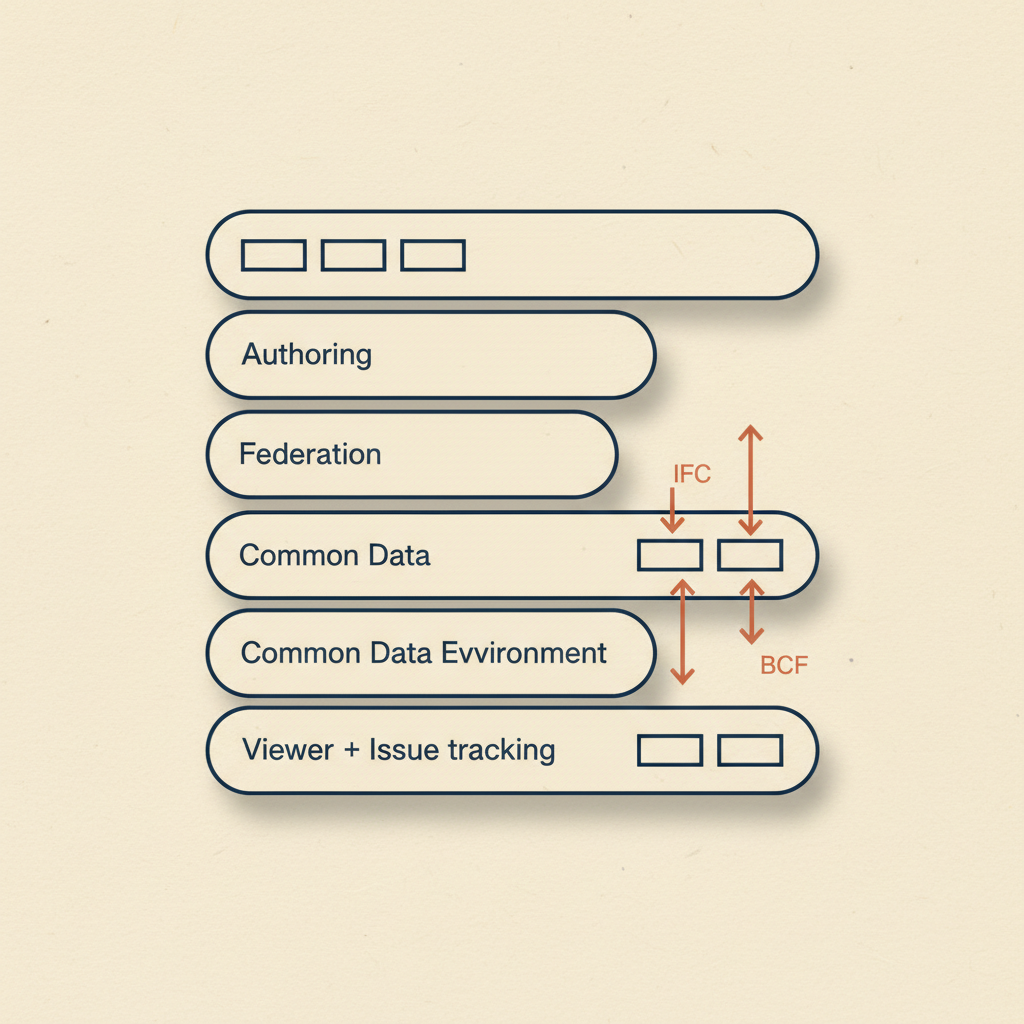
Authoring tools per discipline
- Architecture: Autodesk Revit 2024 or 2025 (never mixed on one project). Occasional ArchiCAD from Türkiye-based teams, federated via IFC.
- Structural concrete: Revit Structure, analytical export to ETABS or Robot.
- Structural steel: Tekla Structures 2025 for fabrication-grade detailing, exported back as IFC 4.3.
- MEP: Revit MEP is common; teams in Dubai frequently deliver Navisworks federations already containing coordinated MEP geometry.
- Civil and site: Civil 3D, exported to IFC 4.3. Infrastructure alignment data is where IFC 4.3 earns its keep, because IFC 4.0 and 4.1 could not represent linear placement adequately.
Common Data Environment
Autodesk Construction Cloud (ACC) is a common primary CDE on cross-border projects, with Trimble Connect a frequent secondary, for example where a steel subcontractor will not surrender existing licences. Both are ISO 19650-aligned. Neither is perfect. ACC regional routing allows a project to be pinned to EMEA storage, which matters for UAE clients who write data-residency clauses into the contract.
Coordination and issue tracking
BIM Collaboration Format (BCF) is non-negotiable. Every clash, every coordination question, every model-quality flag travels through BCF, not email and not WhatsApp screenshots. BIMcollab Zoom is a common choice for federation viewing and BCF issue management. A typical cadence has Navisworks running clash detection on the federated set midweek, the report converted to BCF, and open issues reaching the discipline leads the next morning.
Citation Capsule"The federated digital twin is a contract artefact before it is a technology artefact. ISO 19650 information management plans, an enforced IFC 4.3 exchange schema, and BCF-tracked issue resolution survive the eighteen-month software refresh cycle. The authoring tools do not. Standardise the exchange. Negotiate the rest."
Which jurisdictions accept which BIM compliance levels?
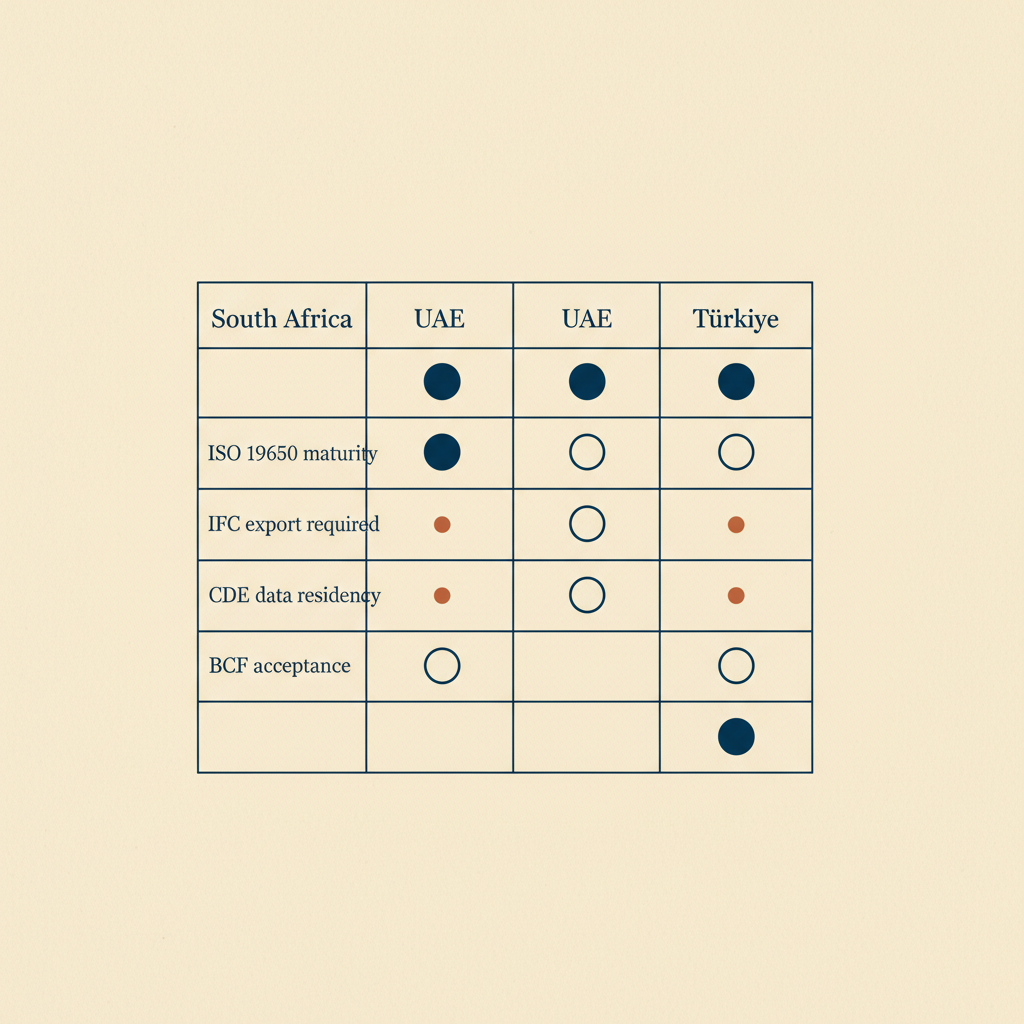
This is where cross-border delivery diverges most sharply from single-country practice. South Africa, the UAE, Libya and Türkiye sit at four different points on the openBIM maturity curve.
Dubai and the UAE
Dubai Municipality made BIM submission mandatory in January 2024 for architectural projects over 20,000 m² or 20 floors, structural projects over 30,000 m² or 40 floors, and all government and specialised-facility projects. The mandate explicitly references ISO 19650, IFC, Information Delivery Specification (IDS) and BCF. A compliant submission needs an Asset Information Requirements document, a BIM Execution Plan, federated IFC 4.3 files, and BCF logs evidencing clash-resolution discipline.
South Africa
The CIDB has the SANS national annex to ISO 19650 in active development and the mandate framework is phased over a five-year horizon. Peer-reviewed analysis in Frontiers in Built Environment outlines the phasing: amend the PPP Manual and issue a BIM Schedule of Services in the first eighteen months, regional BIM Labs in the medium term, and ISO 19650 criteria embedded in CIDB grading by year five. For now, large public-sector projects accept ISO 19650 voluntarily; private institutional clients increasingly require it. A pragmatic approach is to deliver every South African project to the ISO 19650 standard regardless, because that is what keeps the model portable to Dubai or Istanbul without a translation phase.
Türkiye
Türkiye's BIM pilot mandate took effect across 2024 and 2025 for public buildings over 20,000 m², with the Ministry of Environment, Urbanization and Climate Change, KGM (highways), DHMİ (airports) and TOKİ publishing BIM-required technical specifications. The practical challenge in Türkiye is not the mandate itself but the fragmented vendor landscape: Tekla dominates structural steel, ArchiCAD has stronger architectural penetration than in the other three countries, and a non-trivial number of local subcontractors still detail in 2D CAD. The IFC 4.3 exchange schema allows those models to be accepted without forcing a software change on the subcontractor.
Libya
Libya has no national BIM mandate. Reconstruction-funded projects driven by international agencies inherit the donor's BIM requirements, which commonly track ISO 19650 closely. Libyan delivery is best treated like private-sector South African work: ISO 19650 by default, IFC 4.3 federation, BCF issue tracking, even when not contractually required.
Where coordination actually fails in practice
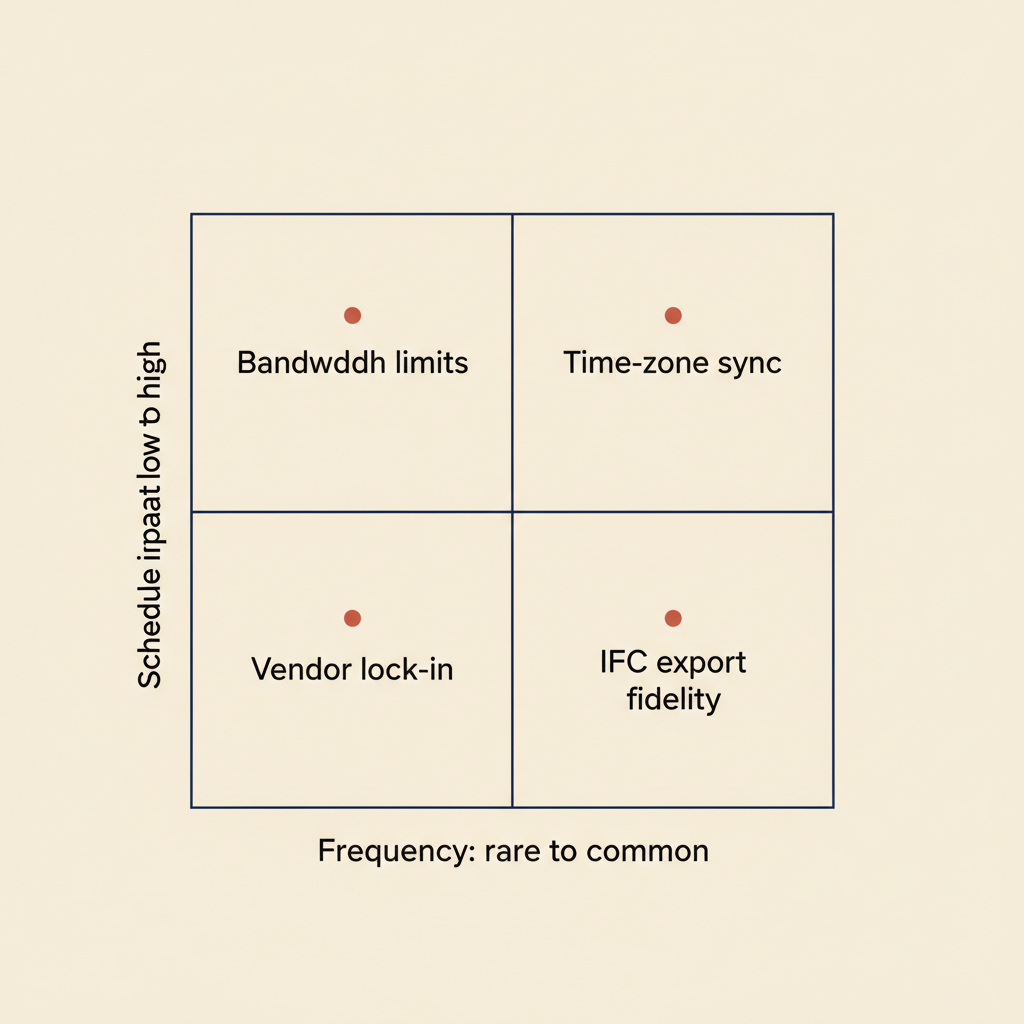
This is the section that engineering blogs usually skip because it makes the vendors uncomfortable. The failure modes below are the ones that recur most often on cross-border projects.
IFC 4.3 export fidelity is uneven
Autodesk has confirmed that IFC 4.3 files exported from Civil 3D or Revit cannot be opened in Navisworks 2023 with the older importer. Even on Navisworks 2024 and 2025, IFC 4.3 reference-view handling continues to evolve, and teams have seen geometry simplification on infrastructure alignments that the source Civil 3D model represents perfectly. A common standing rule is to run every IFC 4.3 export through the buildingSMART Validation Service before it lands in the federated CDE folder: the exporter is not to be trusted, no matter the version.
Federation coordinate-system drift
Revit's default Origin-to-Origin behaviour when linking IFCs from Tekla causes models to align correctly in Navisworks and Solibri while sitting in the wrong place in Revit, a coordinate-system mismatch documented across both vendors' user forums. The workaround: publish IFC from Tekla using the internal origin, hold a reference block in the base model for alignment, and document the survey-control offset in the BIM Execution Plan. Sounds trivial. On a project with sixteen contributing models spread across multiple offices it is not.
Model-server bandwidth across continents
Model-server latency, between a Cape Town engineer opening a federation hosted on ACC EMEA and the same federation opened from Tripoli or Benghazi on a 4G connection, is the single most underestimated risk on cross-border projects. ACC and Trimble Connect both stream model data; neither performs well below about 10 Mbps stable upstream. Research on federated digital twin architectures confirms what is observed on site: centralised twins develop latency and bottleneck issues that distributed-edge approaches mitigate, but construction has not yet productised those edge patterns.
Time-zone sync on review cycles
Four-country teams span a six-hour window from Cape Town through Tripoli, Istanbul and Dubai. A federation refresh that lands at 17:00 Dubai time arrives at 15:00 in Tripoli and 14:00 in Istanbul, but at 13:00 in Cape Town. A robust control is to pin the weekly federation merge to a fixed UTC slot, document the next-day review window in the BEP, and refuse to chase "urgent" model uploads that arrive outside the agreed cadence. This is a process control, not a software control. The software cannot enforce it.
BCF discipline is a human problem
BCF is implemented across every major coordination platform, and yet the failure mode is almost always the same: a discipline lead resolves a clash in the model, marks the BCF issue closed, but does not export the updated BCF back to the federation tracker. The issue silently re-opens on the next clash run. A sound internal rule: no clash issue is closed until the closing-BCF transmittal sits in the project audit log. It is a learned discipline that teams typically take months to internalise.
What to standardise versus what to let go
This is the operational core of the article, and the question every project director asks.
Standardised, hard line:
- ISO 19650 information management plan and BEP, with appendices country-specific
- IFC 4.3 as the exchange format for every federated model
- BCF for every coordination issue, no exceptions
- Common Data Environment selection (ACC or Trimble Connect) fixed at project kickoff
- Survey-control point, project base point and shared coordinate offset locked in writing before any model is published
- Weekly federation merge at a fixed UTC slot
Negotiated, deliberately:
- Authoring tool per discipline (Revit, ArchiCAD, Tekla, Civil 3D, ETABS and Robot are all workable)
- Software version, within a published compatibility range
- Clash-detection tool (Navisworks, Solibri or BIMcollab Zoom)
- Local file-naming conventions that extend rather than replace the ISO 19650 base structure
Standardising the authoring tool does not work; attempts to enforce a single tool across all disciplines fail. Standardise the exchange schema and the governance, accept authoring heterogeneity, and the cross-border model holds together. This matches the 2024 systematic review of digital twin applications in construction, which identifies multi-source data heterogeneity and poor tool interoperability as the two dominant unsolved problems, precisely the problems the federated openBIM approach absorbs rather than eliminates.
A note on what the digital twin is not, yet
The marketing layer promises sensor-coupled, real-time, AI-augmented building models. Across commercial and residential projects, that vision is rarely seen fully delivered into operations. The handover model is rich, federated, IFC-compliant. The post-occupancy IoT integration that turns the federated model into a live twin remains a one-to-three-year client-led programme. The honest deliverable: a federated as-built model handed over under ISO 19650, instrumented as the client commissions sensors. The "twin" matures over the first eighteen months of operation, not on practical completion day.
For related services and work, see the civil and structural and architectural design service pages, recent projects and case studies.
Frequently asked questions
Is a federated BIM model the same as a digital twin? add
No. A federated BIM model is a coordinated set of discipline models exchanged through a common data environment. A digital twin adds a live data layer: occupancy, sensor readings, energy data, asset performance, fed back into the model in near real time. The federated model is the prerequisite. The twin is the post-occupancy maturity layer that develops over the first one to three years of operation.
Which BIM software stack do we recommend for a four-country project? add
The common recommendation is to select per discipline rather than per project. Revit and Tekla for structural concrete and steel, Civil 3D for infrastructure, Revit or ArchiCAD for architecture, ETABS or Robot for analytical, all exchanging via IFC 4.3. The Common Data Environment is best selected once at kickoff and held: ACC or Trimble Connect, both ISO 19650-aligned.
Does the Dubai BIM mandate apply to consultants based outside the UAE? add
The mandate applies to the project submission, not the consultant's location. Any project meeting the threshold (20,000 m² architectural, 30,000 m² structural, government and specialised facilities) must submit a compliant BIM package. Foreign consultants deliver through a local partner or registered branch office. The model itself must meet ISO 19650, IFC and BCF requirements regardless of where it was authored.
How do we handle a subcontractor still working in 2D CAD? add
The workable approach is to accept the 2D deliverable, model the relevant geometry into the federation at the appropriate level of information need, and version-control the source 2D as a reference document attached to the IFC object. This is common in Türkiye and Libya: a managed compromise, not a long-term position.
What is the realistic timeline to bring an ISO 19650-compliant cross-border BIM workflow online? add
For a multinational firm new to the framework, allow six to nine months from a standing start: three months for the information management plan and templates, three months for pilot rollout with embedded coordination support, two to three months to internalise BCF discipline. Faster claims tend to skip the BCF step and rediscover the gap on the second project.
How much does the federated digital twin add to project fee? add
BIM coordination adds a modest uplift to professional fee when a project is delivered to ISO 19650 from the start. The uplift is higher on retrofit-BIM projects, where the workflow has to be built mid-project rather than planned from kickoff.