Why procurement timelines drift twice as long as developers assume
Procurement officers at international developers tend to forecast tender-to-award duration from one familiar market and extrapolate. That is the first mistake. A Cape Town municipal water contract, a Dubai federal services tender, a Derna reconstruction package, and an EKAP-listed Istanbul roadworks bid run on four distinct statutory clocks. The minimum advertising periods are different, the bond instruments are different, the languages of contract are different, and the dispute-resolution venues are different.
This article gives you the country-by-country breakdown that lets you calibrate a realistic procurement schedule before you commit a Gantt bar to your board.
How long does South African public engineering procurement take?
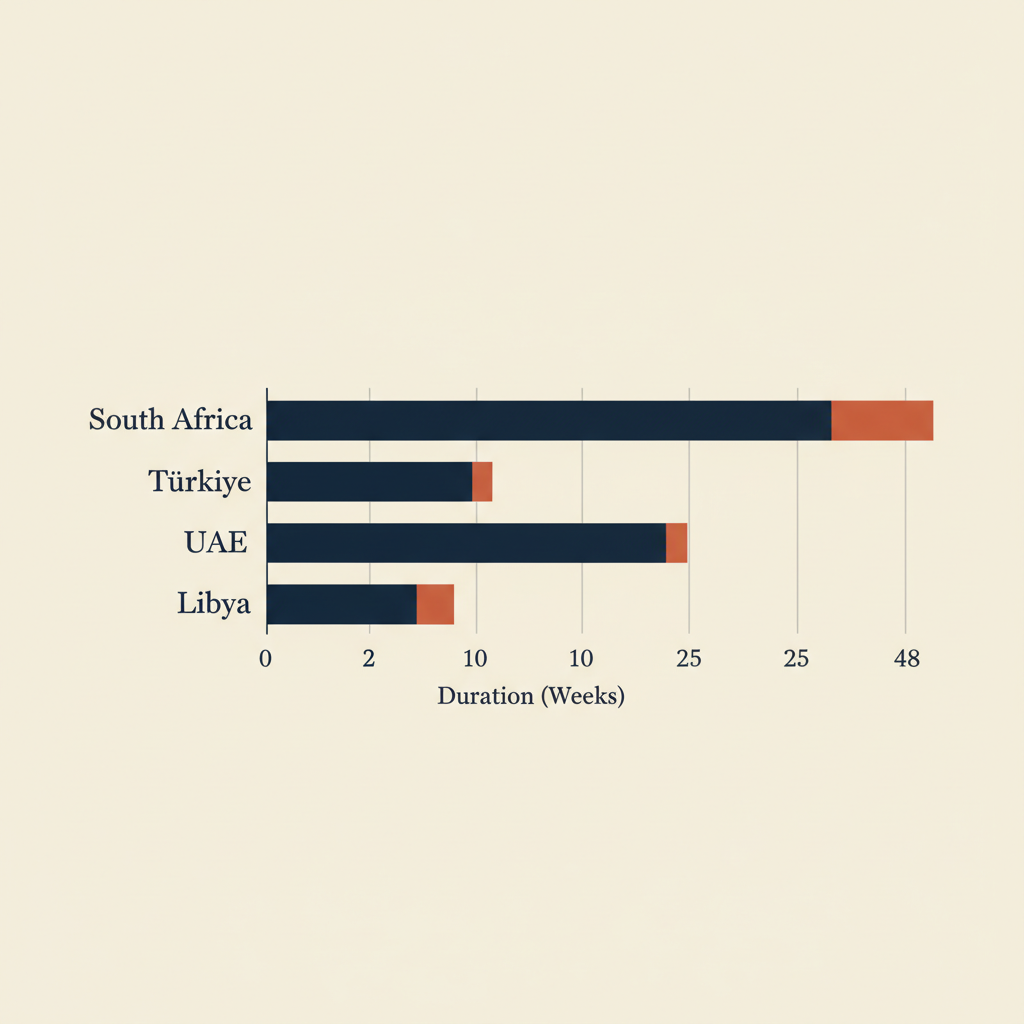
Answer: South African public engineering procurement runs six to ten weeks from advertisement to award under normal conditions. The Public Finance Management Act regime sets a minimum advertising period of twenty-one working days for standard open tenders and thirty working days for complex or high-value construction work, with briefing sessions usually falling on day five to seven of the advertising window. Bond and tax-clearance steps add two to four weeks after preferred-bidder notification.
The governing instruments are the Preferential Procurement Policy Framework Act of 2000 and, increasingly, the Public Procurement Act of 2024, which the National Treasury is rolling out in phases through 2025 and 2026. The 2024 Act consolidates PPPFA, PFMA, and MFMA procurement rules into a unified framework that emphasises transparency and digital submission, according to the Treasury-published MAPS assessment. Until the new regulations are fully operational, existing PPPFA timelines continue to apply (defenceWeb, December 2024).
For engineering and construction work, the Construction Industry Development Board's Standard Conditions of Tender govern the technical content of the response. CIDB grading determines who may bid at what contract value, and the grading certificate must be valid on the day of submission. Foreign firms are eligible but typically partner with a CIDB-graded local entity to satisfy the local-content thresholds in the PPRA's 80/20 and 90/10 preference-point system.
Citation CapsuleSouth African public engineering tenders run twenty-one to thirty working days of advertising under the PPPFA regime, with the new Public Procurement Act of 2024 phasing in through 2026. CIDB grading certificates must be valid on submission day. Realistic RFQ-to-signed-contract elapsed time is six to ten weeks for standard work, longer where preferred-bidder objections trigger a Section 217 review.
For how this work is run from our head office, see the Ace Cape Town office page.
How does UAE federal procurement compare?
Answer: UAE federal procurement is the fastest of the four. Under Federal Decree-Law No. 11 of 2023, the Ministry of Finance runs all federal tenders through the Digital Procurement Platform, with advertising windows usually four to six weeks for engineering services and four to eight weeks total from RFQ to contract signature. Performance bonds run five to ten percent of contract value, and advance-payment guarantees are common practice when mobilisation precedes the first interim valuation.
The legal frame is set by Federal Decree-Law No. 11 of 2023 on procurement in the federal government, which replaced earlier procurement legislation and consolidated all federal entities onto a single digital platform. Emirate-level procurement (Dubai eSupply, Abu Dhabi Government Procurement Gate) runs on parallel but distinct portals, each with its own qualification rules. The UAE Government's tendering portal lists the active federal opportunities.
On bond mechanics, Article 880 of the UAE Civil Transactions Law and the standard FIDIC clauses commonly used in the region set the framework. Al Tamimi & Company's note on FIDIC bonds and Fenwick Elliott's UAE bond review both confirm that performance bonds typically sit at ten percent of contract value, occasionally five percent on lower-risk packages. Advance-payment bonds match the advance amount and amortise against interim certificates.
The UAE-specific risk that international developers underprice is the "on-demand" character of UAE bonds. Most performance bonds issued by UAE banks are unconditional on-demand instruments. The employer can call the bond without proving default. In practice this rarely happens with reputable employers, but it shifts the contractor's risk posture materially compared with conditional bonds in other jurisdictions. Build the bond-call risk into your pricing, not your contingency.
Visit the Ace Dubai regional page for the federal procurement lead.
How does Libyan reconstruction procurement actually work in 2026?
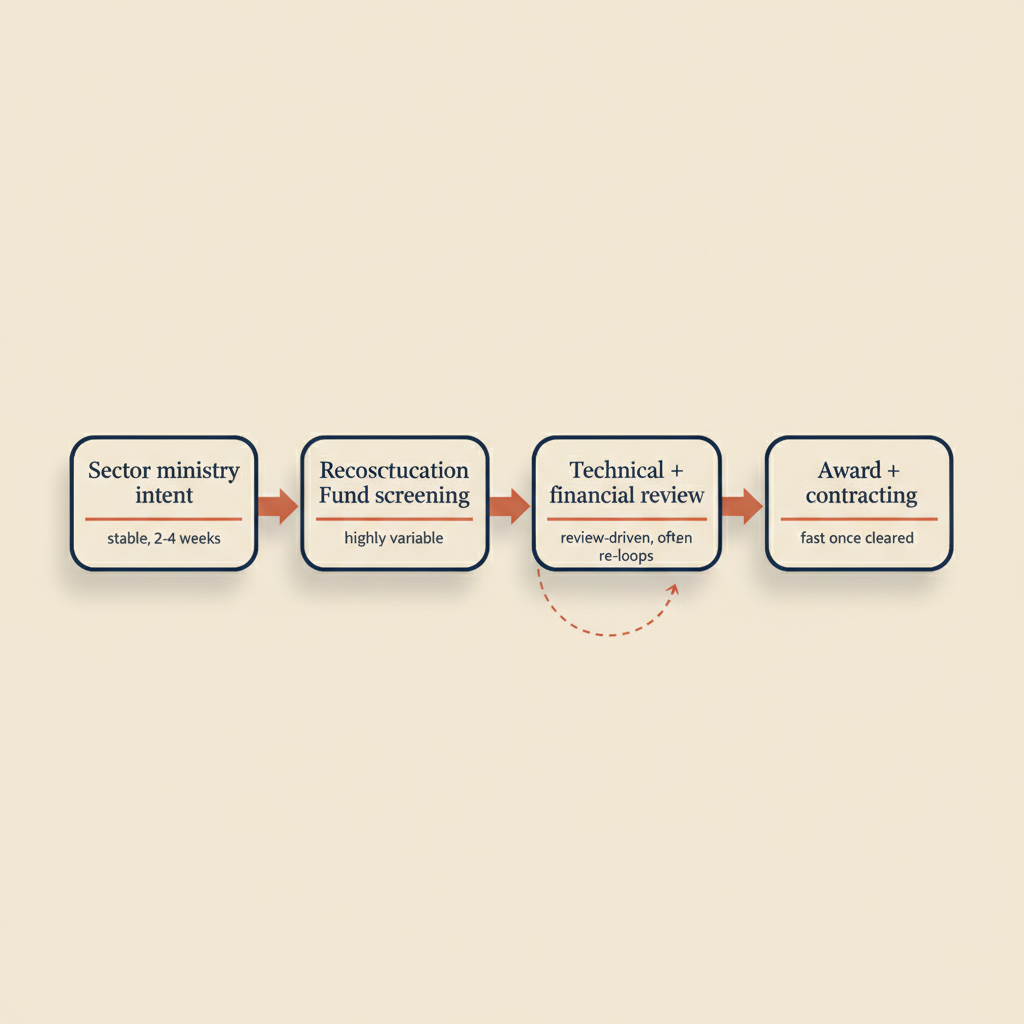
Libya is the outlier in this four-country set. The procurement system is functional but slow, the reconstruction pipeline is large, and the security environment shapes every commercial decision. Engineering firms entering Libya in 2026 should price their proposals on the assumption that the elapsed time from RFQ to signed contract will be twelve to twenty weeks, not the regional six-to-ten norm.
The macro context is the September 2023 Derna flood. The joint World Bank, EU, and UN Rapid Damage and Needs Assessment, released January 2024, put reconstruction and recovery needs at USD 1.8 billion, of which roughly seventy percent is infrastructure. More than 18,500 houses were destroyed or damaged across the worst-affected municipalities of Derna, Soussa, Al-Bahda, Al-Marj, and Shahhat (ReliefWeb summary).
That is a real engineering pipeline. The procurement vehicle is mixed: some packages flow through the Central Tender Board, others through municipal authorities, and the larger reconstruction work increasingly flows through specialised reconstruction agencies under the General Authority for Reconstruction and Stabilisation.
Language: contract is in Arabic. An English translation may sit alongside the Arabic master, but the Arabic version controls. Get the translation done by a sworn translator in Tripoli, not remotely. Disputes default to Libyan civil courts in most public contracts, although arbitration clauses referencing the Cairo Regional Centre for International Commercial Arbitration are not unusual on larger packages.
See the Ace Tripoli regional page for more on Libyan procurement.
How does Türkiye's EKAP system compare?
Answer: Turkish public engineering procurement runs through the EKAP electronic platform under Public Procurement Law No. 4734, with realistic RFQ-to-signature timelines of ten to fourteen weeks. The Open Procedure (Açık İhale) is the default for all procurements above the legal threshold, and tender notice periods under Article 13 typically range from twenty-five to forty days depending on procurement value and whether the package was pre-advertised. FIDIC contract forms are standard practice.
The governing instruments are Law No. 4734 (Public Procurement Law) and Law No. 4735 (Public Procurement Contracts Law), as summarised in the ICLG Turkey/Türkiye public procurement report for 2025. EKAP registration is mandatory and runs through the Public Procurement Authority (Kamu İhale Kurumu, KİK), which also handles tender objections and complaints, as the Tenders.go Türkiye guide notes.
Performance bonds are governed by Articles 33 to 35 of Law No. 4734 and typically sit at six percent of the contract value, lower than the UAE and SA defaults. Bid bonds run three percent. The bond instruments must be issued by Turkish banks or by foreign banks with correspondent arrangements that satisfy KİK's eligibility rules.
See the Ace Istanbul regional page for the EKAP and tender-objection lead.
What does the country-by-country comparison actually look like?
This is the procurement realism table to keep on the proposal-team wall.
| Variable | South Africa | UAE | Libya | Türkiye |
|---|---|---|---|---|
| Statutory frame | PPPFA 2000, Public Procurement Act 28 of 2024 (phasing in) | Federal Decree-Law 11 of 2023 | Mixed: CTB rules, municipal codes, GARS-led reconstruction | Law 4734, Law 4735 |
| RFQ-to-award (realistic) | 6 to 10 weeks | 4 to 8 weeks | 12 to 20 weeks | 10 to 14 weeks |
| Minimum advertising period | 21 working days (standard), 30 (complex) | Set per package, typically 4 to 6 weeks | Not uniformly published; varies | 25 to 40 days per Article 13 |
| Performance bond | 5 to 10 % | 5 to 10 % (commonly 10 %, on-demand) | 5 to 10 %, sometimes higher for foreign bidders | 6 % (Article 33) |
| Bid bond | 1 to 2 % | 1 to 2 % | 1 to 3 % | 3 % (Article 33) |
| Advance-payment guarantee | Optional, matches advance | Common, matches advance | Common, often required | Optional, governed by contract |
| Contract language | English | English / Arabic (Arabic prevails federal) | Arabic (controls) | Turkish (controls) |
| Standard contract form | NEC3 / NEC4, GCC 2015, FIDIC | FIDIC (Red, Yellow, Silver) | FIDIC, bespoke government forms | FIDIC, KİK standard contract |
| Dispute resolution default | Adjudication, then arbitration (AFSA / AAA), local courts | DAB then arbitration (DIAC, ICC, ADGM, DIFC-LCIA) | Libyan civil courts; Cairo Regional Centre on larger packages | Turkish courts; ICC arbitration on larger packages |
| Notable risk | Tax-clearance re-issue delays at contract finalisation | On-demand bond calls | Security-driven schedule slip, FX volatility | EKAP objection extensions |
Sources: cited inline throughout the article. Multi-tiered FIDIC dispute clauses in the MENA region per the Global Arbitration Review MENA guide. Last updated 16 June 2026.
What does this mean for proposal scheduling?
Three rules carry across all four countries.
First, the statutory minimum advertising period is not the realistic timeline. It is the floor. The real elapsed time from RFQ issue to executed contract sits two to three weeks above the statutory minimum on most packages, and four to eight weeks above on complex ones.
Second, the bond-and-guarantee step is the most underestimated. Foreign bidders without an established local banking relationship routinely lose two to four weeks issuing the performance bond after preferred-bidder notification. That window is not in the tender programme; it sits inside the contract-finalisation window and pushes the construction-start date out by the same amount.
Third, the contract-language and dispute-resolution defaults are the single largest hidden cost. Arabic-controlling and Turkish-controlling contracts must be translated, reviewed by local counsel, and reconciled with the engineering technical clauses before signature. Budget a sworn-translation review of two to three weeks on Libyan and Turkish packages.
For a deeper view of how we sequence these against our programme and project management workflow, and the four-country lead structure described on our about page, the procurement programme is built around two parallel critical paths: the tender response itself and the bond-and-guarantee mobilisation. The two paths converge at preferred-bidder notification.
Frequently asked questions
What is the realistic RFQ-to-award timeline for international engineering procurement in South Africa, the UAE, Libya, and Türkiye?
Roughly six to ten weeks in South Africa, four to eight weeks in the UAE, twelve to twenty weeks in Libya, and ten to fourteen weeks in Türkiye, from RFQ issue to executed contract. The wide Libyan range reflects security-driven schedule slip on packages that include site work in the eastern reconstruction corridor.
What performance bond rates apply in each country?
Five to ten percent of contract value is the regional norm in South Africa and the UAE, with UAE bonds usually issued as unconditional on-demand instruments. Libya runs at five to ten percent, occasionally higher for foreign bidders without local banking history. Türkiye is fixed at six percent under Article 33 of Law No. 4734, with a three percent bid bond.
Which language controls the contract in each country?
English in South Africa. English and Arabic in the UAE federal tender system, with Arabic prevailing in case of conflict. Arabic in Libya, with English translations alongside but Arabic controls. Turkish in Türkiye, with Turkish controlling.
What is the default dispute-resolution venue?
South Africa: adjudication followed by arbitration, commonly through AFSA, with local courts as backstop. UAE: a Dispute Adjudication Board followed by arbitration, with DIAC, ICC, ADGM, or DIFC-LCIA the common seats. Libya: Libyan civil courts in most public contracts, with the Cairo Regional Centre for International Commercial Arbitration on larger packages. Türkiye: Turkish courts on smaller packages, ICC arbitration on larger ones, with the multi-tiered FIDIC dispute clause widely respected.
When does the new South African Public Procurement Act of 2024 fully replace the PPPFA?
The Act was signed in 2024 and is rolling out in phases through 2025 and 2026. Existing PPPFA, PFMA, and MFMA procurement rules continue to apply until the corresponding sections of the new regulations take effect. Track the National Treasury Office of the Chief Procurement Officer circulars for the live implementation status.
What are the most common scheduling mistakes foreign developers make?
Three: assuming a single regional procurement timeline applies across all four countries, underestimating the bond-and-guarantee window after preferred-bidder notification, and failing to budget sworn-translation review time on Arabic-controlling and Turkish-controlling contracts.
Where can I find live tender opportunities?
South Africa: National Treasury eTender Portal and DIRCO tenders. UAE: Ministry of Finance Digital Procurement Platform plus Dubai eSupply and Abu Dhabi Procurement Gate. Libya: Central Tender Board listings and IOM Libya tenders for international donor work. Türkiye: EKAP under the Public Procurement Authority.